The 13th Science Europe High Level Workshop on the ERA
On Wednesday, 24 November Science Europe held the 13th edition of its High Level Workshop on the European Research Area, with a focus, this year, on the topic of research culture.

Member-only content is available on this page. Please log in to view this content.
720 item(s) found
On Wednesday, 24 November Science Europe held the 13th edition of its High Level Workshop on the European Research Area, with a focus, this year, on the topic of research culture.
At the recent SE General Assembly on 25 November 2021, the Science Europe Member Organisations elected the members of the Science Europe Governing Board for the next two-year mandate, 2021-2023.
On the occasion of the 2021 High Level Workshop, Science Europe celebrated its 10th anniversary and its achievements during that period.
Science Europe welcomes the adoption by the Council of the European Union of the Conclusion on the future governance of the European Research Area and Recommendations on a Pact for Research and Innovation.
Funders’ event at conference highlights the pandemic’s lessons for fighting climate change, says Eleanor Smith.
The new statement on Research Culture envisages an ERA that focusses on the quality of research and its processes, supports scientific freedom, and promotes social diversity and inclusion, acknowledging that these conditions will, in turn, foster a productive research system.
On 25 November 2021, Science Europe releases a vision for Research Culture in the European Research Area (ERA) and commits to collective actions that enable a thriving research system.
Science Europe position paper aims to steer outcome of ministerial meeting later this week
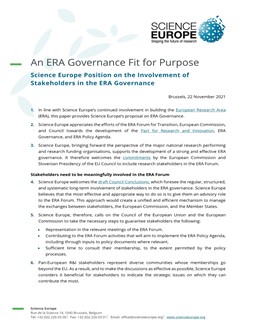
Science Europe Position on the Involvement of Stakeholders in the ERA Governance
At the COP26 UN climate conference in Glasgow, groups representing universities and research funders have called on their peers to join them in committing to more ambitious actions on climate change.
Report of the 7 September Science Europe Policy Workshop 'Science for the Green Transition', co-organised with CSIC, FORMAS, and UKRI. The goal was to study the roles and contributions of research organisations and governments to the green transition.
The partners of the Science for Net-Zero Symposium CESAER, the International Sustainable Campus Network (ISCN), Science Europe, and the University of Strathclyde are calling for a collaborative, systems-based approach to tackling the Net-Zero emissions challenge, and are taking immediate steps to lead by example.
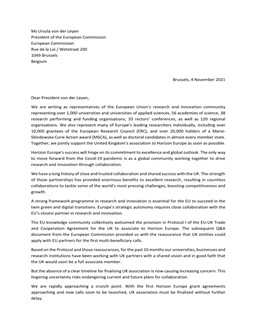
The European Union’s research and innovation community urges the European Commission and UK Government to work towards a successful UK association to Horizon Europe as soon as possible.
Countries are falling well short on emissions targets, but the first day of the UN conference saw fresh commitments, with the new US strategy underlining the central role research and innovation will play in delivering climate neutrality
On 26-27 October 2021, the Slovenian Presidency of the Council of the European Union organised the “Conference New ERA - Towards a responsible knowledge driven society of the 3rd Millennium.” It was intended to better integrate the ERA in key stakeholder communities, industrial sectors and policymakers on regional, national and EU levels, especially those responsible for research and from broader innovation ecosystems.
The Nobel Prizes were announced between 4 and 11 October this year, honouring the greatest achievements in medicine, physics, chemistry, literature, peace, and economic sciences.
Science Europe was launched formally in its first General Assembly on 21 October 2011 in Berlin. A total of 49 Member Organisations, including the seven official founding members (DFG, ESRC, ETAg, FWO, FNRS, ARRS, and SNSF), celebrated the start of the association and elected its first President, Paul Boyle, and Governing Board.
On 24 November, Science Europe, in collaboration with the Luxembourg National Research Fund (FNR) and the Luxembourg Ministry of Higher Education and Research (MESR), will organise the 13th high Level Workshop – this year on the topic of ‘Research Culture’.
Want to join us and help us strengthen innovative European research? Science Europe currently has an open vacancy for the post of Policy Officer.
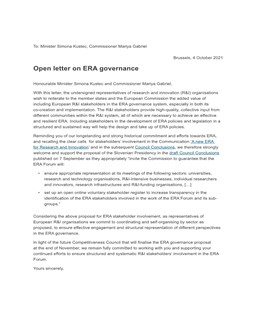
With this letter, the undersigned representatives of research and innovation (R&I) organisations wish to reiterate the added value of including European R&I stakeholders in the ERA governance system, especially in both its co-creation and implementation.
Maria Leptin will not join until 1 November due to clashing commitments in her calendar, but research lobbies are sanguine about the delay.
Member state governments’ move to slash EU funding labelled “extremely disappointing”, especially in “unusual” times.
The research is there, but scientists are having trouble getting their voices heard. In the lead up to COP26, funding agencies are calling on scientists to be better at communicating their findings.
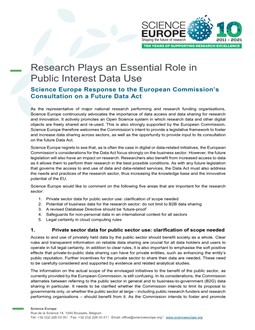
Science Europe Response to the European Commission’s Consultation on a Future Data Act