Member-only content is available on this page. Please log in to view this content.
EU Legislation
Legislation decided at EU level can have a large impact on the European research ecosystem. To reinforce Europe’s world-class research, it is essential to have a regulatory framework in place that benefits research excellence, openness, and international collaboration. Science Europe is active on a range of legislation topics that have an impact for research.
Why does EU legislation matter?
The objective of the European Research Area (ERA) is to build a common scientific and technological area for the EU that will help create a more competitive European industry. This area should be based on the free movement of researchers, scientific knowledge, and innovation. The EU frequently implements legislation that (in)directly changes the framework conditions for European research.
Researchers and research organisations need clear rules that help advance research and innovation. EU legislation therefore needs to respond to their evolving needs and practices. To realise ERA, this legislation must promote excellence, openness, and collaboration. When legislation does not aim to regulate research, but does affect it – such as when regulating data and digitalisation, it must build on cross-sectoral synergies to provide the best conditions for high-quality science.
What are the current priorities?
The European Research Area focuses on:
- promoting researcher mobility and knowledge flows
- incentivising investments in research and innovation
- improving gender equality and diversity in science
- fostering co-operation between different research stakeholders
Further crucial priorities in the coming years will be to:
- address the consequences of the COVID-19 pandemic
- address other societal challenges, such as climate change
- build a more resilient society
To achieve a well-functioning ERA, coherent policies need to be developed at regional, national, and EU level. European authorities must work closely together with national and pan-European research stakeholders. They must develop forward-looking rules that fit the challenges that the world faces.
What does Science Europe do to achieve these aims?
Science Europe is a trusted partner of the EU Institutions and regularly shares the expertise and experience of its members with them. It does so in particular in areas related to the Green Deal, digital transformation, societal challenges, and COVID-19. It thereby contributes to the development of a legislative framework that is beneficial to research and helps us to respond to both existing and future challenges.

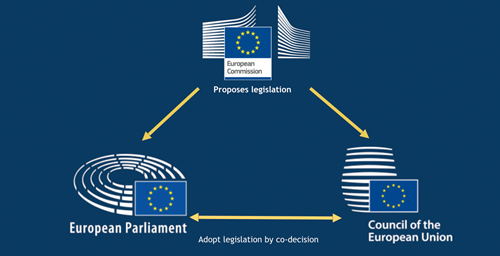
How does the EU legislative process work?

Related content
Science Europe Response to the Call for Evidence on the Revision of EU Public Procurement Guidelines
Science Europe has submitted a response to the European Commission’s call for evidence on the revision of the EU public procurement directives, focusing on the role of green and circular public procurement in research and research-related activities.
Science Europe Response to the Public Consultation on the ERA Act
Science Europe has responded to the European Commission’s public consultation on the proposed European Research Area (ERA) Act, setting out the collective views of its Member Organisations on how the legislation can effectively strengthen framework conditions for research and innovation, while safeguarding academic freedom, institutional autonomy, and the diversity of national research systems.
Science Europe response to the Call for Evidence on a European Innovation Act
Science Europe's recommendations on the European Innovation Act emphasise support for excellent research, breakthrough innovation, and strong alignment with the upcoming ERA Act. The Act should maintain Horizon Europe’s autonomy for R&I-focused projects, foster talent circulation, strengthen research-industry collaboration, and enhance access to Research and Technology Infrastructures.
Unlocking the Fifth Freedom: Science Europe Response to the Call for Evidence on the ERA Act
Science Europe has submitted its response to the European Commission’s Call for Evidence on the upcoming European Research Area (ERA) Act. The ERA Act represents a major opportunity to create a true single market for research and innovation – often referred to as the “fifth freedom” – by strengthening research excellence, shared values, and cross-border collaboration.
2024 Annual Report: Advancing Excellence, Realising Impact
Science Europe made excellent progress on its research policy priorities in 2024, delivering key outputs in various areas, including science communication, research assessment, open science, the sustainability of research, international collaboration, and equality, diversity, and inclusion.
Report of High-level Conference 'Unlocking the Power of Science Communication in Research and Policy Making'
This report summarises the High-level Conference on Science Communication organised by Science Europe, FWO, and FNRS. The event emphasised the role of science communication, the importance of integrating it into research programmes and policies, and providing support for those engaging in it.
From Ambition To Action: Fostering Research Excellence In Europe - 2023 Annual Report
2023 proved to be another landmark year for Science Europe: building on the achievements of the previous year and setting the direction for new approaches in vital areas of research policy.
Research Matters Open Letter: A call to strengthen research and innovation in Europe
Science Europe has joined other research and higher education organisations in a call to increase and strengthen investment for research and innovation at European and national level and protect R&I budgets, as part of the Research Matters campaign.
Vote for Science: 5 Pledges for Candidates of the European Parliament Elections 2024
In the run up to the European Parliament Elections on 6-9 June 2024, Science Europe has launched our 'Vote for Science' Campaign advocating for political support for science research in the EU legislative agenda of the next 5 years. In the interests of securing this support, Science Europe encourages candidates for the European Parliament to consider and commit to 5 pledges to safeguard the future of European research and innovation.
Vote for Science: Factsheet on Science Research in Europe
In the run up to the European Parliament Elections on 6-9 June 2024, Science Europe has launched our 'Vote for Science' Campaign advocating for political support for science research in the EU legislative agenda of the next 5 years. As part of our campaign, we've created a factsheet offering a look at the state of science research in Europe, to help voters in understanding how we are doing in supporting science across the areas of our 5 Pledges for Candidates.