
Member-only content is available on this page. Please log in to view this content.

Academic Freedom
Academic freedom is necessary for scholars to pursue evidence, advance knowledge, and produce high-quality research. It is also fundamental for research to contribute to a more prosperous and sustainable future.
Why does academic freedom matter?
Scientific discoveries and technological developments are crucial for society to thrive. However, research can only contribute to a prosperous and sustainable future if it is conducted according to certain fundamental principles: academic freedom and institutional autonomy.
Academic freedom is essential to ensure that research is of the highest attainable quality. It guarantees scholars the freedom of thought and inquiry they need to advance knowledge, as well as the freedom to communicate the results of their work and educate the next generation of critical thinkers.
What are the current priorities?
It is essential to research that scholars are free to communicate ideas or facts without the fear of reprisal, job loss, or imprisonment. To that end, they must be able to undertake their activities free from undue external interference. In some parts of Europe, academic freedom is no longer self-evident, with grave consequences for scholars, science, and society. The fundamental importance and value of academic freedom and institutional autonomy must be recognised and these values must be guaranteed to all scholars in Europe.
What is Science Europe doing to achieve these aims?
Science Europe promotes the fundamental importance of academic freedom and institutional autonomy. Together with ALL European Academies (ALLEA) and the European University Association (EUA), Science Europe published a statement calling on governments and public authorities to protect academic freedom, safeguard institutional autonomy, and respect funding and scientific decisions by research organisations.
This includes guaranteeing scholars the rights that underpin academic freedom - such as the rights to freedom of expression, opinion, thought, information and assembly, as well as the rights to diverse research and to engage in a trust-based dialogue with researchers and research organisations.
Related content

03.09.2026
Strengthening Academic Freedom & Institutional Resilience in the European Research Area
This report explores the evolving challenges facing academic freedom and highlights the role of institutional autonomy, sustainable funding, research integrity, and supportive research environments in safeguarding it. It also identifies priorities for strengthening academic freedom across the European Research Area.

16.07.2026
2025 Annual Report: Delivering Excellence in a Changing World
This Annual Report provides an overview of the progress and achievements of Science Europe across the research policy topics that it worked on in 2025, including FP10 development, research culture, trust in science, research security, Artificial Intelligence, research assessment, environmental sustainability, inclusion, and open access.

23.01.2026
Science Europe Response to the Public Consultation on the ERA Act
Science Europe has responded to the European Commission’s public consultation on the proposed European Research Area (ERA) Act, setting out the collective views of its Member Organisations on how the legislation can effectively strengthen framework conditions for research and innovation, while safeguarding academic freedom, institutional autonomy, and the diversity of national research systems.
10.09.2025
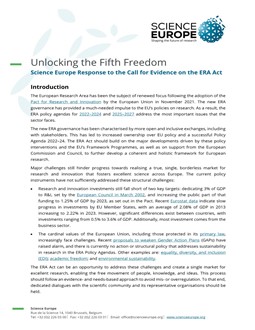
Unlocking the Fifth Freedom: Science Europe Response to the Call for Evidence on the ERA Act
Science Europe has submitted its response to the European Commission’s Call for Evidence on the upcoming European Research Area (ERA) Act. The ERA Act represents a major opportunity to create a true single market for research and innovation – often referred to as the “fifth freedom” – by strengthening research excellence, shared values, and cross-border collaboration.
15.07.2025
2024 Annual Report: Advancing Excellence, Realising Impact
Science Europe made excellent progress on its research policy priorities in 2024, delivering key outputs in various areas, including science communication, research assessment, open science, the sustainability of research, international collaboration, and equality, diversity, and inclusion.
08.03.2025
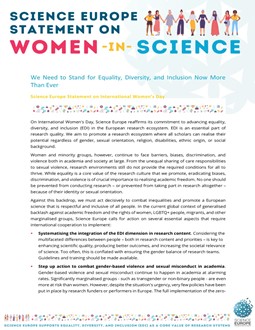
Science Europe Statement on International Women's Day
On International Women's Day, Science Europe reaffirms its commitment to advancing equality, diversity, and inclusion (EDI) in the European research ecosystem as an essential part of research quality. We aim to promote a research ecosystem where all scholars can realise their potential regardless of gender, sexual orientation, religion, disabilities, ethnic origin, or social background.
19.12.2024
Report of the 2024 High Level Workshop on the ERA
This report presents a summary of the dialogue sessions and main conclusions of the 2024 High Level Workshop that took place in Budapest on 19 and 20 November. The event was organised by Science Europe in partnership with the Hungarian Research Network (HUN-REN) and the Hungarian Academy of Sciences (MTA), under the auspices of the Hungarian Presidency of the Council of the European Union.
04.12.2024
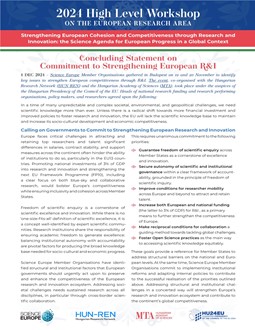
Concluding Statement on Commitment to Strengthening European R&I
This statement presents the key conclusions from the 2024 High Level Workshop on 'Strengthening European Cohesion and Competitiveness through Research and Innovation' and a set of priorities for achieving this.
22.07.2024
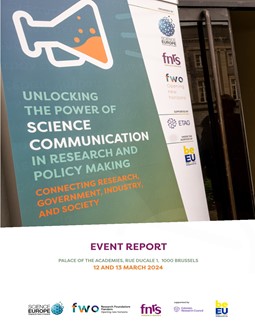
Report of High-level Conference 'Unlocking the Power of Science Communication in Research and Policy Making'
This report summarises the High-level Conference on Science Communication organised by Science Europe, FWO, and FNRS. The event emphasised the role of science communication, the importance of integrating it into research programmes and policies, and providing support for those engaging in it.
04.07.2024
From Ambition To Action: Fostering Research Excellence In Europe - 2023 Annual Report
2023 proved to be another landmark year for Science Europe: building on the achievements of the previous year and setting the direction for new approaches in vital areas of research policy.
MORE?